


Contents:
- Why Sunflower Pairings Matter More Than You Think
- The Best Flowers to Pair With Sunflowers in a Bouquet
- Purple and Blue Blooms: The Classic Complement
- Warm Tones: Rusts, Oranges, and Burgundy
- White and Cream: The Neutral Balancers
- Greenery and Filler: The Unsung Heroes
- Seasonal Pairings: What to Choose and When
- A Real-World Pairing Lesson
- Practical Tips for Building Your Bouquet
- Frequently Asked Questions
- What flowers go best with sunflowers in a summer bouquet?
- Can roses be paired with sunflowers?
- How many sunflowers should be in a bouquet?
- What greenery pairs well with sunflowers?
- Do sunflowers and lavender go together in a bouquet?
- Build Your Next Bouquet With Intention
Sunflowers make almost any bouquet better — but the wrong pairing can make them look like an afterthought instead of the star. Knowing which flowers pair well with sunflowers in a bouquet is the difference between a grocery store grab-bag and something that stops people mid-sentence to ask, “Where did you get that?”
The good news: sunflowers are generous partners. Their bold yellow faces and sturdy stems play well with dozens of companion blooms. The trick is understanding why certain combinations work, so you can build arrangements confidently instead of guessing.
Why Sunflower Pairings Matter More Than You Think
Sunflowers are visual anchors. At 4–6 inches across for standard varieties like ‘Autumn Beauty’ or ‘Lemon Queen,’ they immediately draw the eye. Everything else in the bouquet either supports that focal point or fights it. Your job is to surround them with blooms that add contrast, texture, or color harmony — not competition.
Color theory is your friend here. Sunflowers sit in the yellow-orange range of the color wheel, which means they have natural chemistry with purples and blues (complementary), rusts and bronzes (analogous), and creamy whites (neutral balance). Build your pairings around one of those three relationships and you’ll rarely go wrong.
The Best Flowers to Pair With Sunflowers in a Bouquet
Purple and Blue Blooms: The Classic Complement
Nothing makes a sunflower pop like purple. The contrast is bold without being jarring, and it photographs beautifully. Top choices include:
- Lavender: Adds fragrance and a feathery, airy texture. Use 5–7 stems per sunflower for balance.
- Purple lisianthus: Ruffled petals that echo the fullness of sunflowers without copying their shape.
- Veronica (Speedwell): Tall, spiky stems that add vertical interest and a rich violet-blue tone.
- Blue delphinium: A dramatic pairing for larger arrangements — expect to pay $8–$15 per stem at a florist, but the visual payoff is significant.
Warm Tones: Rusts, Oranges, and Burgundy
For an analogous palette that feels earthy and abundant — think late summer farmers market — lean into the warm spectrum.
- Rudbeckia (Black-eyed Susan): A natural companion; same family, smaller face, beautiful repetition of the yellow-to-brown gradient.
- Chocolate cosmos: Deep burgundy-brown blooms that mirror the sunflower’s dark center and add moody depth.
- Orange gerbera daisies: Cheerful and widely available, they extend the warm palette without overwhelming it.
- Celosia ‘Dragon’s Breath’: Velvety, flame-shaped clusters in deep red that add texture no other flower can replicate.
White and Cream: The Neutral Balancers
Sometimes a bouquet needs breathing room. White flowers give the eye somewhere to rest between bold sunflower heads.
- White peonies: Lush, full, and romantic — pair one peony with every two sunflowers for scale balance.
- Chamomile: Tiny daisy-like faces that echo the sunflower’s shape at a miniature scale. Brilliant for filling gaps.
- White ranunculus: Layered petals and a compact form that contrast beautifully with the sunflower’s flat, open face.
Greenery and Filler: The Unsung Heroes
A bouquet without strong greenery is like a meal without seasoning — technically complete, but missing something essential. For sunflower arrangements specifically, these fillers earn their place:
- Eucalyptus (seeded or silver dollar): The dusty blue-green color cools down warm palettes and adds a subtle fragrance.
- Wheat stalks: Particularly beautiful in late summer bouquets; they reinforce the harvest aesthetic sunflowers naturally evoke.
- Italian ruscus: Dark, waxy leaves that provide a polished backdrop without drawing attention away from the blooms.
Seasonal Pairings: What to Choose and When
Sunflowers peak from July through September in most of the US, but your companion flower options shift with the calendar. Matching your pairings to what’s in season locally not only saves money (often 30–50% less than out-of-season imports) but also results in fresher, longer-lasting arrangements.
There’s a meaningful regional difference worth knowing here. Gardeners in the Southeast — Georgia, the Carolinas, Tennessee — often work with zinnias, which bloom abundantly in the summer heat and make stunning sunflower companions in coral and magenta shades. Meanwhile, on the West Coast, ranunculus and anemones are available from late winter through spring, meaning California gardeners can extend the “sunflower season” feel into earlier months using cool-toned ranunculus as proxies for traditional warm-weather companions. In the Northeast, where summers are shorter, dahlias and sunflowers overlap in August and September, producing some of the most spectacular combinations of the entire gardening year.
A Real-World Pairing Lesson
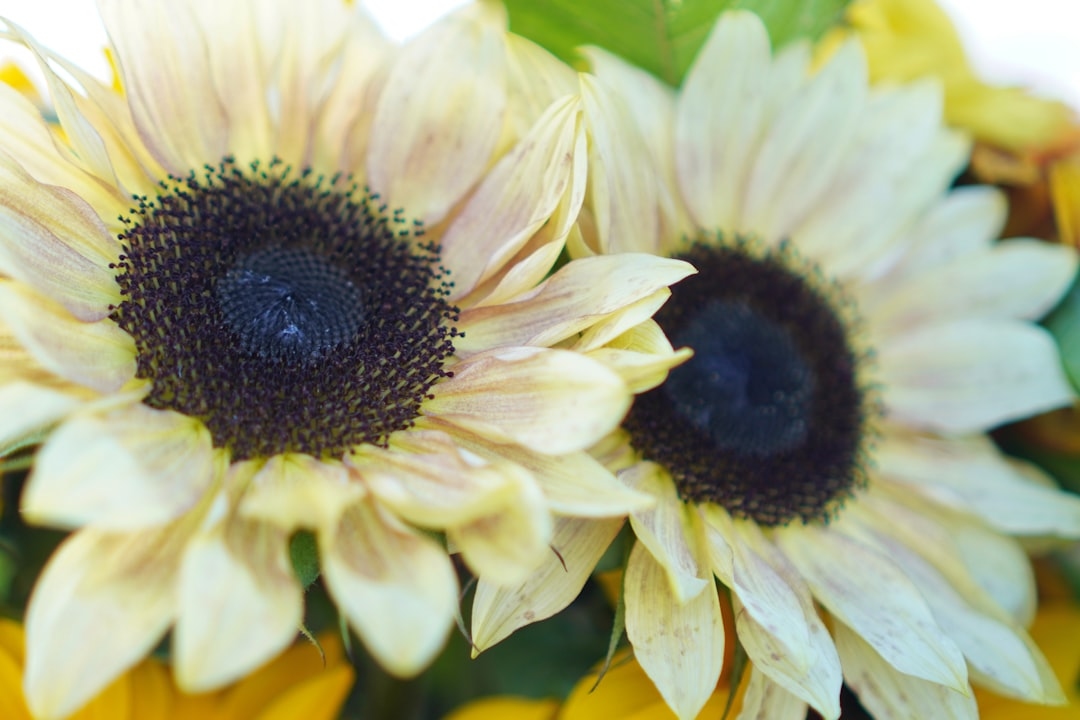
A gardener in suburban Nashville recently shared a hard-won lesson from her first serious attempt at a sunflower arrangement. She’d grown a gorgeous row of ‘Velvet Queen’ sunflowers — deep amber with burgundy centers — and paired them with bright pink gerbera daisies she’d picked up at the grocery store. The result? A bouquet that felt scattered and confused, the pink and amber competing rather than conversing.
Her second attempt swapped the gerberas for chocolate cosmos and a handful of dusty miller for silver-green contrast. Same sunflowers, same vase — completely transformed. The dark blooms echoed the burgundy centers of the sunflowers, and the silver foliage tied it all together. The lesson: match your companion flowers to the specific variety of sunflower you’re working with, not just sunflowers in general.
Practical Tips for Building Your Bouquet
- Use the rule of odds: Arrange sunflowers in groups of 3, 5, or 7. Even numbers feel static; odd numbers feel dynamic.
- Vary stem heights: Cut companion flowers 2–3 inches shorter than your sunflowers so the focal blooms stay visible. Don’t let lisianthus or peonies compete at the same height.
- Condition your stems: Sunflowers are thirsty. Recut stems at a 45-degree angle and place in cool water for at least 2 hours before arranging. This extends vase life from 5 days to closer to 10.
- Limit your palette: Three colors maximum keeps the arrangement cohesive. More than that and it starts to look like a collection rather than a composition.
- Add texture, not just color: Include at least one spiky element (veronica, lavender), one round element (ranunculus, peony), and one airy filler (chamomile, baby’s breath) for visual interest.
Frequently Asked Questions
What flowers go best with sunflowers in a summer bouquet?
In summer, the best companions for sunflowers are zinnias, lavender, rudbeckia, and dahlias. These are all in peak season simultaneously and reinforce the warm, abundant feel of a summer arrangement. White lisianthus also pairs beautifully for contrast.
Can roses be paired with sunflowers?
Yes — garden roses (not spray roses) work particularly well. Choose peach, cream, or coral roses to complement sunflowers’ warm tones. Red roses can clash visually; if you love red, use deep burgundy garden roses instead, which harmonize with sunflowers’ dark centers.
How many sunflowers should be in a bouquet?
For a hand-tied bouquet, 3–5 sunflowers is the standard range. Fewer than 3 can feel sparse; more than 7 starts to overwhelm. Balance each sunflower with 2–3 companion stems and 1–2 greenery stems for proportion.
What greenery pairs well with sunflowers?
Eucalyptus (silver dollar or seeded varieties), Italian ruscus, and wheat stalks are the top three. For a wilder, garden-style look, try trailing amaranthus or fresh herb branches like rosemary or sage.
Do sunflowers and lavender go together in a bouquet?
Absolutely — it’s one of the most classic pairings. The purple-blue of lavender complements sunflower yellow via color contrast, and the fragrance adds a sensory layer that most bouquets lack. Use French or English lavender at roughly 5 stems per sunflower for the right visual weight.
Build Your Next Bouquet With Intention
Sunflowers reward thoughtful partners. Now that you know which companion blooms work and why they work — color theory, texture contrast, seasonal availability, variety-matching — you can move beyond guessing and start designing with real intention. Try one new pairing this season: pick a sunflower variety you’ve never grown, match it to a companion bloom from the same color family, and see what happens. The best bouquet you’ve ever made might be one experiment away.